


📢 Coming Soon: User Details in Raw Interactions

  • August 21, 2025
  • 3 replies
  • 141 views

vpawar
Forum|alt.badge.img+2

We’ve heard your feedback on the accessibility of the Raw Interactions table—and we’re excited to share an important update.

Starting the week of September 15th, the Raw Interactions table will include User IDs and Emails. This update is designed to give you deeper visibility and make it easier to support employees at the individual level.

With this enhancement, you’ll be able to:

  1. Identify the end users who have conversations with the AI Assistant
  2. Filter and analyze conversations for a specific user
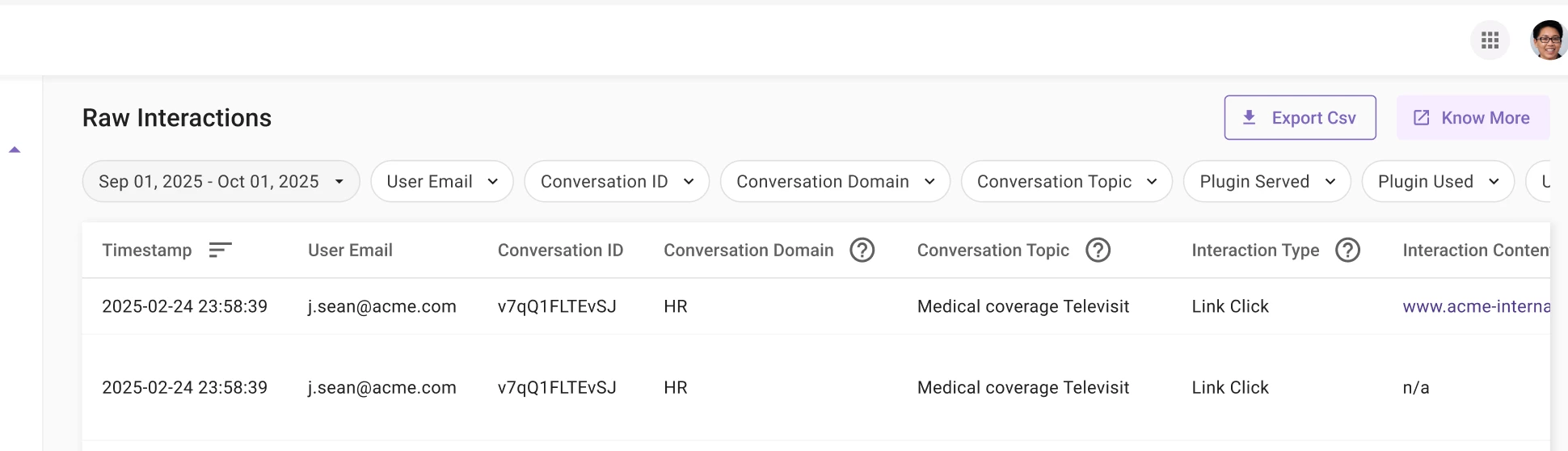


This update comes directly from your input, and it’s another step toward making Moveworks Analytics more actionable and transparent. No action is required on your end—these fields will automatically appear in your Raw Interactions table once the update goes live.

We’ll continue listening to your feedback and making improvements that help you uncover insights faster and support employees better.


3 replies

Forum|alt.badge.img+6
  • Participating Frequently
  • August 26, 2025

Were customers using HR considered in this update?


hundleymf
Forum|alt.badge.img+4
  • Inspiring
  • August 26, 2025

​@vpawar I have a few questions:


Anonymization

  • What exactly counts as “confidential,” and how is it detected?
  • Will you anonymize if a question of a confidential nature is asked?

Controls and opt-outs

  • If you’re unable to anonymize can we opt out of the update so that we don’t see the User IDs or Emails at all?

Content protection

  • Is there automatic redaction or DLP to mask sensitive info typed in chats?
  • Can users or admins mark a conversation as “don’t log content” while still tracking basic usage?

Use of data

  • Will user data be used to train or improve any AI models?
  • If yes, is training limited to our tenant only? Can we opt out of training while keeping analytics?

Incident response

  • If identifiable data is exposed, what’s the notification and remediation process and timeline?

hundleymf
Forum|alt.badge.img+4
  • Inspiring
  • September 10, 2025

I was told this:

Impact to Data Compliance & Product Strategy
We understand this will impact data governance policies. To address this, a data governance layer for analytics is currently in development and expected by the end of October. This will offer:

  • Creation and sharing of custom views of all data products

  • Item level Role Based Access Control

  • Granular permissions for analytics

  • Column masking in interactions table

Separately, data can currently be masked in the Interactions and Feedback table in the Overview section. Email address and User ID can be masked in Moveworks Setup in the Analytics App Settings section (see attachment).


I have some clarifying questions about data masking and the upcoming updates mentioned. It said that email addresses and User IDs can currently be masked in the Interactions and Feedback table, and in the Analytics App Settings within Moveworks Setup. However, when I checked the Analytics App Settings, I didn’t see the masking options shown in your screenshot. Is this feature only available to Moveworks Support, or is it part of the October update?

Additionally, with the October update, it mentioned that Role-Based Access Control (RBAC) will be implemented. I want to check if that means once RBAC is in place, people like my supervisor or myself (super admins) can control masking and unmasking of data without needing support’s help. Is that correct?

From what I understand in the Data Compliance & Product Strategy above, we will be able to choose which columns to mask ourselves, especially if data compliance is now our responsibility after the October update.

Finally, I have a question about unmasking specific conversations. If we have masking enabled for certain columns and need to see a particular conversation—perhaps for security reasons—would we be able to unmask just that one conversation without unmasking everything else? If so, how would that work? Would we need to unmask the data, review the conversation, and then mask the data again?