


Moveworks Beyond MS Teams and AI Assistance
Objective:
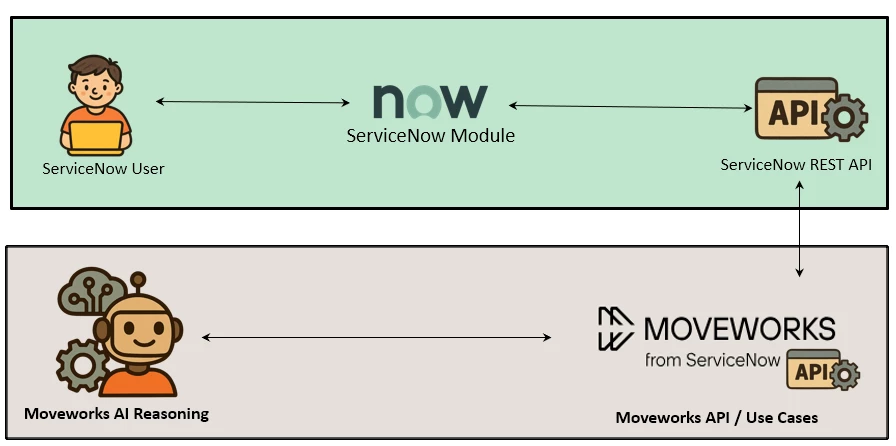
The objective of this design is to enable the consumption of Moveworks Large Language Model (LLM) capabilities from enterprise platforms such as ServiceNow, rather than restricting LLM usage solely to a conversational chatbot interface. This document uses ServiceNow as a reference integration platform to illustrate the approach.
Business Use Case Overview
The proposed integration enables multiple high‑value business use cases designed to improve operational efficiency, service quality, and knowledge reuse across IT and business teams.
The solution supports, but is not limited to, the following cases like:
1. Incident Summarization and Contextual Analysis
The integration enables automatic summarization of incidents by consolidating incident descriptions, activity logs, and resolution notes into clear, concise summaries.
2. Intelligent Solution Generation for Incidents
Based on historical incidents, known errors, and existing knowledge articles, the solution can recommend or generate potential resolutions for newly raised incidents.
3. Automated Knowledge Article Creation
Resolved incidents can be automatically transformed into structured knowledge articles, ensuring organizational learning is captured and reused.
4. Agile Development Support: Documentation and Test Artifacts
The integration supports Agile delivery by generating key artifacts such as:
- Release notes
- Acceptance criteria
- Test cases
- Functional documentation for user stories and requirements
Implementation Overview
The implementation involves integrating Moveworks with ServiceNow to deliver seamless, AI‑driven capabilities directly with ServiceNow platform. This integration enables the availability of ServiceNow‑native forms and modules that allow users to invoke Moveworks use cases designed and governed through the Agentic Studio platform.
The approach ensures that AI capabilities are embedded where users already operate, minimizing disruption while maximizing adoption and business value.
Key Highlights
Native ServiceNow Experience
Moveworks operates directly within the ServiceNow interface, allowing users to leverage intelligent automation without switching platforms or tools.
Platform Independence
The solution is to be independent of Microsoft Teams or Moveworks AI assistants, enabling flexible deployment across business units and reducing reliance on specific collaboration tools. This supports broader accessibility and long‑term scalability.
Reusable Use‑Case Design
Use cases originally designed for MS Teams or AI assistance can be reused and extended within the ServiceNow interface without redesign or redevelopment effort.
Prototype Overview
The prototype has been developed in alignment with the above design, leveraging Moveworks Large Language Model (LLM) skills and publishing the generated responses through ServiceNow‑native modules. The implementation demonstrates end‑to‑end interaction between the two platforms.
The prototype has been implemented using a ServiceNow Personal Developer Instance (PDI) and a Moveworks Sandbox environment.
Moveworks Platform Implementation
The following components were configured within the Moveworks environment to support request handling, orchestration, and secure communication:
- Listener
- Plugin
- Compound action
- HTTP Actions
- Credentials
ServiceNow Platform Implementation
The following ServiceNow artifacts were created to enable invocation, authentication, and user interaction:
- Outbound REST Message and Methods
- Application Registries
- OAuth Entity Profile
- UI Action
- Client script
- Some custom fields
Disclaimer:
- The demonstration is only a working prototype, and it is not a fully equipped E2E solution
- The goal of demonstration is to highlight Moveworks capabilities and possibilities
I shall be documenting required update set from PDI and Moveworks configuration soon...
Check out the video demonstrating same -
Regards,
Rajeev Saraf
LinkedIn - https://www.linkedin.com/in/rajeevsaraf9/