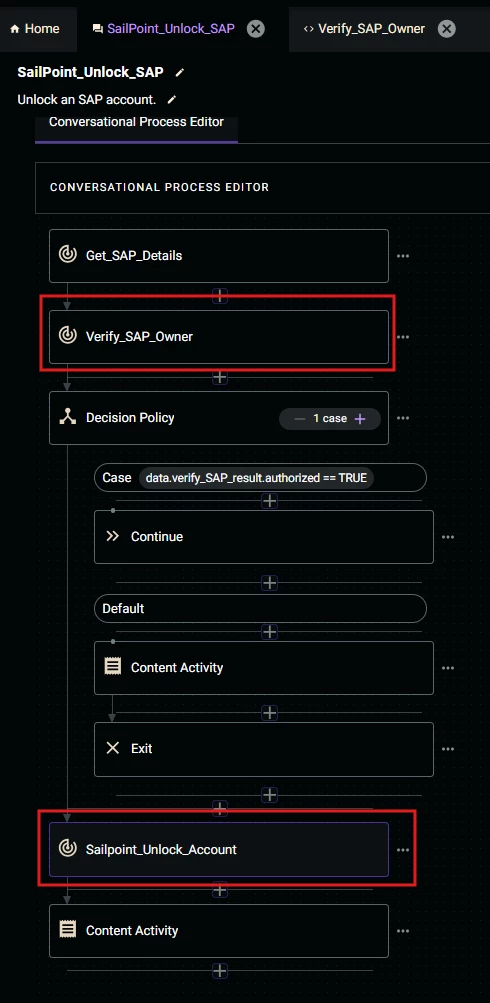
Hi @Derrick!
This type of processing should be utilizing a Compound Action and not a Conversational Process. With a Compound Action, you will have access to the For Loop feature which is what you are looking for.
This When to Use Compound Actions vs. Conversational Processes document helps to outline when to use either asset. Below are the highlights that I would call out:
When to Use Compound Actions
Use compound actions when your workflow is triggered at the system level, without requiring immediate user interaction. They are the go-to for ambient agents, which monitor external signals proactively.
Scenarios
- Event-Driven Automation: Respond to backend events, like a database update or webhook.
- Scheduled Tasks: Run periodic jobs, such as daily reports or cleanups.
- Background Processing: Perform computations or integrations that don't need user input, like syncing data across systems.
Example
In an ambient agent monitoring inventory levels:
- Trigger: System event (stock below threshold).
- Action: Compound action fetches data, calculates reorder quantities, and updates an ERP system.
Advantages: Fast execution, no user dependency, scalable for high-volume tasks.
Limitations: Lacks user context; cannot directly solicit input.
When to Use Conversational Processes
Use conversational processes when triggers are user-initiated and require interactive guidance, validation, or consent. These are core to conversational agents.
Scenarios
- User Input Collection: Gather details via dialogues (e.g., troubleshooting a device issue step-by-step).
- Consent-Driven Actions: Require approvals, like authorizing a purchase or access request.
- Multi-Turn Interactions: Handle complex queries needing clarification (e.g., booking travel with preferences).
Example
In a conversational agent for HR support:
- Trigger: User query ("Request time off").
- Process:
- Ask for dates → collect slot
- Ask for reason → collect slot
- Check policy → action activity (but only one!)
- Route to manager → collect approval
- Submit → trigger compound action for async processing
Advantages: Maintains context for natural conversations, validates inputs in real-time, enhances user experience.
Limitations: Reactive only; not suited for unattended automation.
Best,
Ryan