


"Launch Isn't the Finish Line": Credit Acceptance's Approach to Adoption
Credit Acceptance launched their AI Assistant with a deliberate rollout strategy. By intentionally naming their AI Assistant “Cara Beta,” they signaled that Cara would evolve and improve over time, which encouraged employees to engage and share feedback.
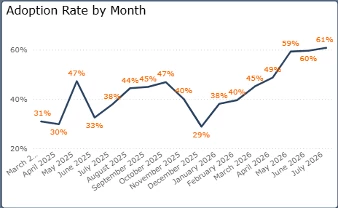
At Cara's one-year mark, the team dropped the "Beta" label and relaunched with a new look and a batch of new capabilities based on user feedback. Adoption climbed from 40% to 60%.
We sat down with Stephanie Wolanin, Business Process Optimization Manager, and Rupa Jakkula, Enterprise Cloud Applications Manager II, to talk through their rollout strategy, navigating change management, and how they drove adoption.
What was Credit Acceptance aiming to achieve with the AI Assistant?
Stephanie: The biggest thing was letting our service desk focus on higher-value work instead of simple things a user could self-serve but typically didn't, because the culture was to pick up the phone. We also really wanted to start adopting AI as an organization, and this felt like a good place to begin.
Since this was your organization's first introduction to AI, how did you approach the launch?
Rupa: That's exactly why we started small. We rolled Cara out to the whole organization, but we kept the scope focused so it wouldn't feel overwhelming. We started with the kinds of things people would normally pick up a phone to call about.
Stephanie: And we launched it as "Cara Beta," which was a big part of it. For a lot of folks, the moment something doesn't work, they're not going to re-engage. By launching Cara Beta, it let us say, "Hey, we never said we were perfect, we're still growing and improving.” It also set up the message that the more people interacted with Cara in the beta state, the better she'd get. That was intentional: we wanted their usage and feedback to be what shaped where Cara went next.
What features did you enable first, and how did you decide?
Rupa: We enabled the native ticketing concierge, because it was low effort on our side, and for the user it was as normal as submitting a ticket, just from Teams instead of the portal. Then we picked the use cases to build based on top ticket and request topics that already had good knowledge documentation. We knew not all of our knowledge articles were AI-ready, and cleaning them all up would have taken a long time, so we started where the documentation was already clean.
Stephanie: A good example is how to get your virtual desktop to go across two monitors. It was one of the biggest incidents our service desk had, and it was already spelled out in a knowledge article. You can just ask Cara and she helps you as well as the service desk could. When I look back at our roadmap, those first few quarters were just putting more information into Cara and telling employees that you could ask her questions or to log a ticket. It sounds small, but it was all about behavior change, and there's huge ROI in that alone, because that's someone not sitting on a phone call with the service desk.
How did you communicate with employees about what to expect from Cara?
Stephanie: We built a landing page on our intranet called “Cara's Garage” and put all our communications there. Anything Cara could do, it went there, so there was one central place for people to get information about her. I recorded walkthroughs and we worked with our CSM to put videos and content together, so people could see Cara in action.
Rupa: We also came up with an FAQ strategy and posted those FAQs in “Cara's Garage.” The important part was that we explained what she could do and why she couldn't answer everything yet. We didn't want someone to come to Cara, hit a wall, and write her off. Being upfront about the boundaries was as important as promoting what she could do.
You wanted employee feedback to shape where Cara went next. How did you collect it?
Stephanie: A few ways. We're a fully remote company, but we do have a building, so on in-office days we'd set up a pop-up where team members could come talk to us. We’d ask: “What are you using Cara for? What are your problems with it?” Sometimes they'd say something we hadn't thought about at all.And most recently, we ran our first Cara community of practice, where we pulled our top 50 users, from all different roles, and asked what they loved and didn't. Their negative feedback was especially valuable. They've completely adopted Cara, so their criticism came from real, daily use rather than a single experience. We have a Center of Excellence where Rupa, myself, and a few other leaders look at our numbers, usage, and decide where to pivot. Everything we hear goes back to the CoE to help inform the roadmap.
Was there any feedback that surprised you?
Rupa: People wanted Cara to feel more like a personal assistant, and they wanted knowledge indexed so their own department's information surfaced first. What struck me, in a good way, was that people weren't just asking a question and moving on. They'd started treating Cara like a true assistant, instead of just a bot.
Stephanie: For me it was communications. We'd been careful not to overwhelm employees’ inboxes so we were cautious about using Cara as another channel. But people told us the opposite: "If you'd just send it through Cara, I'd actually have the reminder." So, we started using her for very targeted messages and it's been really well received.
At Cara's one-year mark you dropped the "Beta" label, rebranded, and relaunched. What did that look like?
Stephanie: We timed it to her one-year anniversary and ran a whole campaign teasing a new look and new features. When the day came, we unveiled the new icon we'd designed and bundled in a batch of new capabilities: resetting your VDI when it's stuck, HR knowledge, and employee communications. It became like a second launch, and you can see it in the data: self-service and deflection both jumped.
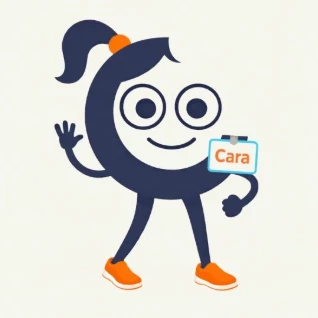
My favorite part: people actually messaged Cara to wish her a happy birthday, so we added a fun response in her FAQs thanking them. Watching everyone treat her like a colleague was the moment we knew adoption had really landed.
What kind of impact have you seen?
Stephanie: Adoption tells the story. We held steady around 40% monthly adoption for the first year, and after the relaunch at the end of February 2026 it climbed steadily into the 60s by mid-2026. Since launch, Cara has supported more than 137,000 interactions and over 57,000 conversations, and helped us avoid upwards of 7,800 tickets. Employee satisfaction has been strong, and Cara is now the primary self-service channel for a lot of our support scenarios.
What would you say to a team that's nervous about launching before they feel "ready"?
Stephanie & Rupa: Communicate, a lot. Be clear that the bot's success is a partnership, and that launch is a starting point, not the finish line. Employees are far more willing to engage with something that's still evolving than you'd expect, especially when they can see their own feedback making it better. The teams that win are the ones that listen, learn, and keep improving based on real usage.